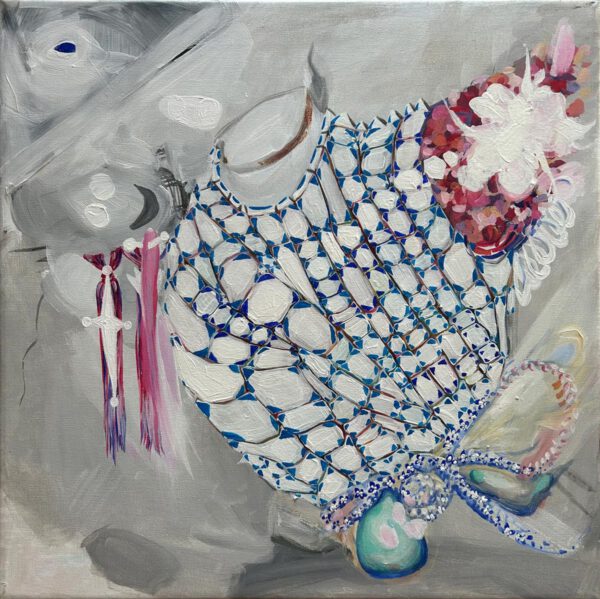
Klassische Malerei – mit verschiedenen Materialien auf Leinwand und Papier – wird immer aktuell bleiben, weil es kaum eine Möglichkeit gibt direkter, gestischer und emotinaler zu arbeiten. Malerei auf großem Format – ein Konzept bei dem Katharina Blanke sich in ihren Arbeiten direkt auf die Grösse eines Menschen und dessen tragbare Gewänder bezieht.


Katharina Blankes Werke sind utopisch - poetische Abbildungen und Konstruktionen von Gewändern. Sie analysiert bestehende Gewandabbildungen und Gewänder, zerlegt diese und reinsziniert sie als neu interpretierte Gewandobjekte. Als Kleiderarchitektur und textile Skulptur, einer hohlen Gewandhülle gleich, macht sie die Darstellung des Gewandes zum personifizierten Objekt. Die Tragbarkeit wird dabei bewusst negiert. Der funktionale Gebrauchsgegenstand wird zum autarken Kunstgegenstand. Die Robenkonstruktion dient als Bildträger und als Kommunikationsmedium für die Identität des Trägers. Es sind sprechende Kleider, deren narrative Oberflächentextur die Bildbotschaft transportiert – eine persönliche Welt der Erinnerung, gebündelt und in Gewandcollagen als Geschichte formuliert. In diesen Kleiderskulpturen treffen Privatmythologie, modische Gattungsgeschichte, Naturgeschichte und Autobiografie aufeinander.


„Ich konstruiere meine Wunsch - Kleider, Phantasiegerüste. Das Gewand, als eine zweite Haut und Identität, wird abgestreift und steht als skulpturales Objekt neben mir. Diese Gewandhülle betrifft mich direkt, ist eine subtile Collage meiner Ideen des lustvollen Kleidens und Verkleidens, welche Wünsche, Sehnsüchte und mein Umfeld widerspiegelt.“


Zu sehen sind opulente Materialorgien in akribischer Detailarbeit. Filigran wuchernde, kunstvoll gewobene komplexe Netzwerke, eine Symbiose von Kunst, Mode und Design, als Malerei, oder Objekt aus Leder, Stoff und Papiermaché ausgearbeitet. Die Arbeiten sind nicht ortsgebunden, sie stehen, oder schweben frei im Raum.


Der theatralische Auftritt der Gewänder in ihrer erstarrten Stofflichkeit lässt Genuss und Verwirrung zu. Die übersteigerte Künstlichkeit dieser narrativen Such - Sucht - Textilien erstaunt und provoziert mit Ironie und Humor. Es verschwimmt die Wahrnehmung von Fiktion und Realität in zauberhaften, versponnenen Labyrinthen. Auf diese Weise entsteht ein Vexierspiel zwischen Anwesenheit und Abwesenheit von Personen, von Erinnerung, Spur, Symbol und Zeichen. Ornamente überall, Tätowierungen gleich, verschmelzen zu einer zweiten Außen(ge)wandhaut. Ebenso zeigt sich in der überbordenden Mischung des Bildinhalts eine Ballung aus Gegenständen alltäglicher Trivialkultur, sowie Essenzen märchenhafter Phantasie.


Katharina Blankes Arbeiten zeigen die pure Lust an schöner Überfülle und an verschnörkelter Üppigkeit – ein Sich - Verlieren, in einer skurril anmutenden Bildwelt. Zudem das Getriebensein, manische Sammelleidenschaft von persönlichen Fundstücken, gebündelt mit der Intention, durch meditative Musterbildung Ruhe zu erlangen. Subtil spielt die Zurschaustellung des prangenden Kleides mit dem Gefühl des Eingeschlossenseins im textilen Käfig zusammen. Anhand austauschbarer Kleiderhüllen wechselt die Künstlerin ihre Identität in der Verkleidung und schlüpft in die Rolle anderer Persönlichkeiten. Doch das Gewand kann auch zum technischen Vehikel werden, zur moralischen Maske des Anstands für das angemessene Sich - Kleiden: das Kleidungsstück als zweite, soziale Schutzhülle und Panzer. Auf diese Weise wird die persönliche Verletzlichkeit durch verdeckende, ablenkende Gewänder nach außen hin geschönt und kaschiert: eine sanfte Rache am Schönheitswahn, welche nun durch übertriebene Fülle und beißende Schönheit überboten wird. Die trotzig - energische Antwort auf ein Trauma, das „Falsche“ zu tragen. Das Verruchte und Böse, verpackt im niedlich-lieblichen Gewand.


Classical painting—working with a wide range of materials on canvas and paper—will always remain relevant, as there are few artistic practices that allow for such direct, gestural, and emotional expression. In her large-scale works, Katharina Blanke relates the dimensions of the painting directly to the scale of the human body and to the wearable garments that surround it.


Blankes works are utopian-poetic representations and constructions of garments. She examines existing depictions of clothing as well as historical and contemporary garments, disassembles them, and re-stages them as newly interpreted objects. Conceived as architectures of dress and textile sculptures, resembling hollow garment shells, they transform the representation of clothing into a personified object. Wearability is deliberately negated. The functional object becomes an autonomous work of art.


The robe-like construction serves simultaneously as image carrier and communicative medium for the identity of its wearer. These are garments that speak: their richly articulated surface textures convey the image’s narrative content—a personal world of memory, condensed and formulated as a history through collages of garments. Within these dress sculptures, private mythology, the history of fashion, natural history, and autobiography converge.


“I construct the dresses I desire, imaginary frameworks. The garment, as a second skin and an expression of identity, is shed and stands as a sculptural object beside me. This garment shell relates to me directly; it is a subtle collage of my ideas about the pleasure of dressing and disguising oneself, reflecting desires, longings, and my surroundings.”


What emerges are opulent material extravaganzas executed with meticulous attention to detail. Delicately proliferating, intricately woven networks form complex symbioses of art, fashion, and design, realized as paintings or as objects fashioned from leather, fabric, and papier-mâché. The works are not site-specific; they stand or hover freely within space.


The theatrical presence of these garments, their materiality seemingly arrested in time, allows for both pleasure and disorientation. The heightened artificiality of these narrative textiles—driven by a compulsive search and desire—astonishes and provokes through irony and humour. The boundaries between fiction and reality become blurred within enchanted, intricate labyrinths. A subtle interplay emerges between the presence and absence of the human figure, between memory, trace, symbol, and sign.


Ornament proliferates throughout the works, reminiscent of tattoos, merging into a second outer skin—a garment-skin. At the same time, the excessive accumulation of imagery brings together objects from everyday trivial culture with fragments and essences of fairy-tale fantasy.


Katharina Blanke’s works reveal an unabashed delight in beautiful excess and ornamental abundance: an invitation to lose oneself within a strangely compelling visual world. At their core lies both a restless drive and a manic passion for collecting personal found objects, combined with the intention of finding calm through the meditative construction of patterns.


The conspicuous display of the sumptuous garment subtly evokes its opposite: the sensation of being enclosed within a textile cage. Through interchangeable garment shells, the artist shifts her identity through acts of disguise, inhabiting the roles of other personalities. Yet the garment can also become a technological vehicle, a moral mask of propriety, enforcing the socially sanctioned conventions of appropriate dress. Clothing becomes a second social protective layer, a kind of armour.


In this way, personal vulnerability is concealed beneath garments that beautify, distract, and disguise the self from the outside—a gentle act of revenge against the tyranny of beauty, now surpassed by excessive abundance and an almost biting beauty. It is a defiant, energetic response to the trauma of wearing the “wrong” thing. The sinister and the sinisterly seductive are wrapped within an ostensibly sweet and innocent exterior.


The works are available for purchase! Prices upon request!


top
Widerrufsrecht
0

Ihr Produktkorb

Quantity: 0 Items: 0
The Cart is Empty
No Porduct in the Cart!
0,00 €
0,00 €
€0.00